

AI in Cybersecurity for Agriculture and Food Webinar




External Speakers
Key Strategic Takeaways
Attackers are increasingly using AI to analyse documentation, understand detection thresholds, and identify gaps in legacy security tools. This allows them to fine-tune attacks, such as staying below alert thresholds in brute-force or login-based scenarios, effectively bypassing controls designed for less adaptive threats. Defending against this requires moving beyond static rules toward behaviour-based detection and continuously evolving security logic.
AI is being used not just for generic attacks, but for targeted campaigns aimed at stealing intellectual property in sectors like food and agriculture. Reports highlight growing concern around AI-enabled espionage, where sensitive production methods, formulations, and operational data are exfiltrated for competitive advantage. Organisations must treat IP as a primary security asset and apply the same level of protection as financial or personal data.
In food and agriculture, AI is deeply integrated into IoT, SCADA, and production environments, analysing telemetry and optimising outputs such as crop yield and production efficiency. While this improves performance, it also increases the attack surface and creates new pathways for compromise if these systems are not secured. Security strategies must account for AI as part of operational infrastructure, ensuring monitoring, segmentation, and governance extend into these environments.
AI is accelerating phishing, fraud, and ransomware by enabling attackers to create highly targeted, scalable campaigns, including impersonation of suppliers and financial fraud at significant scale. At the same time, defenders are using AI to rapidly correlate alerts, detect anomalies, and reduce investigation time from minutes to seconds. The advantage goes to organisations that operationalise AI effectively, using it to augment analysts while maintaining human oversight for critical decisions.
AI introduces new risks around data leakage, particularly when sensitive information is unknowingly shared with external AI tools or APIs. Regulations such as the EU AI Act and GDPR increase accountability, requiring organisations to monitor AI usage, manage incidents, and control data flows. The priority is clear: implement data discovery, classification, and governance controls before scaling AI, supported by a holistic view of people, processes, and technology.

- 00:00 Introduction to AI and cybersecurity in the food and agriculture sector
- 01:44 How attackers are using AI to study security tools and evade detection
- 03:24 AI-enabled IP theft and growing sector-specific threats in food and agri
- 04:16 From blockchain hype to AI-driven protection and automation
- 05:03 EU AI Act, NIS2, and the regulatory impact on food and agriculture
- 08:32 How AI is being embedded into crop, yield, and production environments
- 10:47 Using AI to detect suspicious behaviour across production systems
- 11:37 How AI is changing SOC analyst workflows and investigation speed
- 13:05 Third-party assets, hidden servers, and detecting what was never onboarded
- 15:17 Why AI should support analysts, not make final response decisions
- 18:30 Practical next steps: mapping AI use cases to safety and compliance needs
- 20:13 AI-driven phishing, supplier fraud, and the need for holistic risk reviews

AI as a Force Multiplier for Defenders
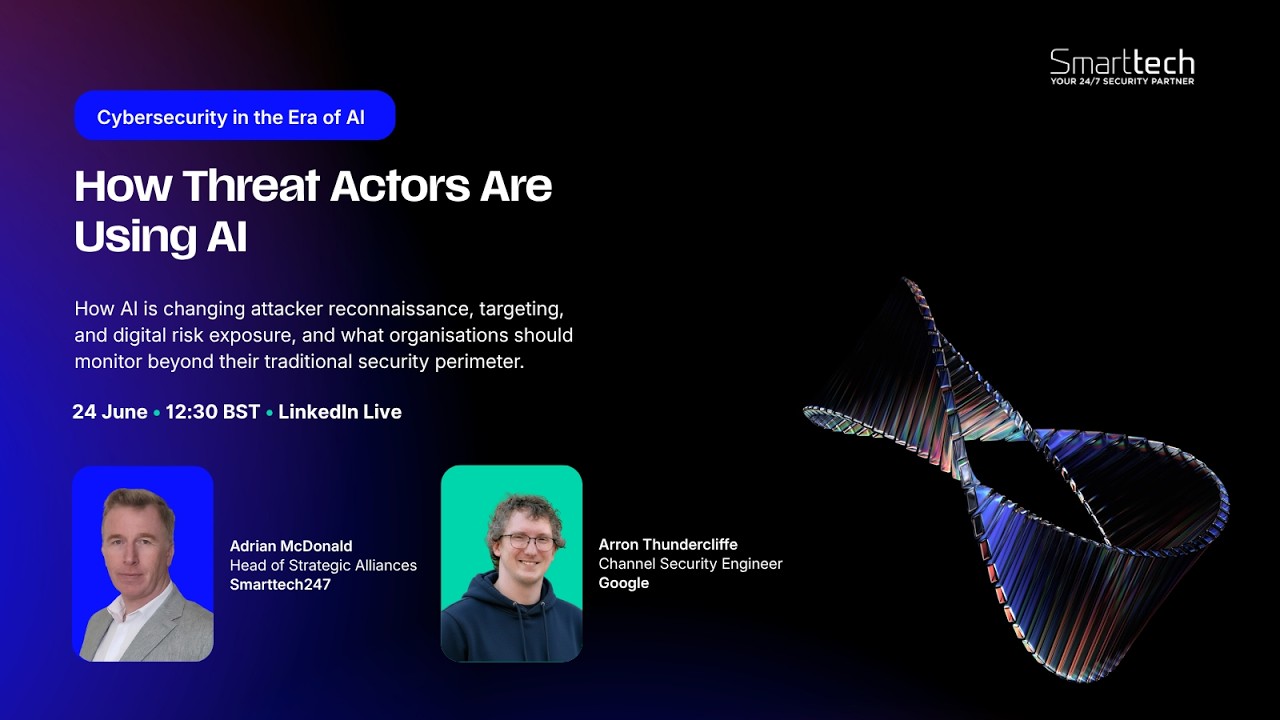
How Threat Actors Are Using AI

Building a Winning Cybersecurity Strategy
Ready to scale your security and compliance operations?
We protect your on-premise/cloud/OT environments - 24x7x365