
Bg Shape
Image

Incident Detection for GDPR Compliance

Smarttech247 Research Team
Insights and Intelligence
Published:
October 14, 2025

The General Data Protection Regulation (GDPR) doesn’t just focus on how organisations collect and store data. It also demands that they know when that data has been compromised and can prove they acted fast. Without strong incident detection and response capabilities, even a small breach can escalate into a regulatory and reputational disaster.

Under GDPR, every organisation handling EU personal data must be able to detect, report, and investigate security incidents. Article 33 is clear. You have 72 hours to notify regulators once you become aware of a breach. That’s not much time. If you don’t have the systems and people in place to spot an incident quickly, compliance becomes impossible.

GDPR is intentionally technology-neutral. While Articles 33 and 34 define when and who organisations must notify following a personal data breach, the regulation deliberately avoids prescribing how incidents should be detected.

That responsibility falls squarely on the organisation. As outlined in Article 32, rather than mandating specific tools or controls, GDPR expects organisations to implement “appropriate technical and organisational measures” based on their risk profile. In practice, this means being able to:

  • notice anomalous or suspicious activity
  • identify whether that activity constitutes a security incident
  • assess whether personal data is involved
  • determine whether the incident qualifies as a reportable personal data breach

Only once those steps are completed can an organisation be said to have “become aware” of a breach and trigger the 72-hour notification requirement under Article 33, which is why having a clearly defined incident response plan is critical. Good incident response management initiavtives provide the operational discipline behind this obligation, ensuring incidents are detected, escalated, and stabilised within defined timeframes, and that performance can be measured, improved, and demonstrated through metrics such as Mean Time to Detect (MTTD) and Mean Time to Respond (MTTR). This approach gives organisations flexibility, but it also removes excuses. If an incident goes undetected for weeks or months, regulators will not accept the absence of tooling or visibility as a defence. They will assess whether reasonable measures were in place to identify the breach in a timely manner.

Why Detection Capability Determines GDPR Outcomes

In regulatory investigations, late reporting is rarely treated as an isolated failure. It is usually a symptom of deeper issues, such as inadequate monitoring, fragmented visibility, or unclear escalation paths.

Organisations that struggle to detect incidents early often face the same problems:

  • limited insight across endpoints, networks, and cloud environments
  • alert fatigue masking real threats
  • manual investigation slowing decision-making
  • poor correlation between security events and data exposure

Without effective detection and response capabilities, GDPR compliance becomes reactive rather than demonstrable. Organisations may eventually report a breach, but they cannot prove that they took reasonable steps to identify and contain it promptly.

Why Detection Sits at the Heart of GDPR

  1. Speed determines compliance
    You can’t respond to what you can’t see. Monitoring tools, threat intelligence, and alerting systems give you the visibility you need to act before that 72-hour clock runs out.
  2. Proof of due diligence
    Regulators expect evidence that you had detection measures, audit logs, and documented response workflows in place before an incident occurred.
  3. Minimising impact on data subjects
    Early detection reduces harm to individuals. If you can contain a breach quickly, fewer records are exposed, and customers maintain trust.
  4. Reducing financial and reputational fallout
    GDPR penalties can reach up to 4% of annual global turnover. Rapid detection and containment demonstrate accountability and can mitigate enforcement action.

Closing the Detection Gap with Managed Detection and Response

This is where managed detection and response (MDR) becomes a practical enabler of GDPR compliance.

Smarttech247’s Managed Detection and Response (MDR) service provides 24/7 SOC monitoring, detection engineering, and incident response across critical environments. By combining human expertise with advanced analytics, MDR helps organisations identify suspicious activity early, assess its impact, and respond decisively before regulatory timelines are breached.

MDR supports GDPR obligations by:

  • detecting potential security incidents in real time
  • investigating whether personal data is affected
  • preserving forensic evidence and audit trails
  • enabling faster, more confident breach assessment

Rather than relying on best-effort monitoring, organisations gain a consistent, defensible detection capability aligned to regulatory expectations.

Building a GDPR-Aligned Detection Capability

  1. Implement continuous monitoring
    Use SIEM, MDR, or XDR platforms to monitor network and endpoint activity around the clock. Continuous visibility is essential for identifying suspicious events in real time.
  2. Develop an incident response plan
    Define clear roles and escalation paths. Include technical teams, compliance officers, and PR functions. Test the plan regularly with tabletop exercises.
  3. Document everything
    From detection to resolution, maintain full audit trails. Logs prove you took reasonable measures — that evidence is critical during a regulatory review.
  4. Integrate detection with data protection measures
    Connect your detection tools with your data classification and access control systems. When an alert fires, you can instantly understand what kind of personal data is at risk.
  5. Leverage automation where possible
    Automated correlation and alerting help teams respond faster and reduce false positives. The faster you can confirm a breach, the faster you can comply.
  6. Work with trusted partners
    Managed detection and response (MDR) providers can bridge capability gaps, offering around-the-clock coverage and forensic support when your internal teams are stretched.

Visibility and Accountability with VisionX

Detection alone is not enough. Security leaders also need visibility and assurance.

VisionX, Smarttech247’s MDR platform, provides a transparent view of live threat intelligence, active investigations, and response actions. It gives CISOs and compliance teams real-time insight into what is happening across their environment, without waiting for incident summaries or post-event reports.

For GDPR compliance, this visibility is critical. VisionX enables organisations to:

  • demonstrate awareness of security events as they unfold
  • understand which assets and data types are at risk
  • support timely internal escalation and regulatory decision-making
  • evidence due diligence during audits and investigations

By combining continuous detection with clear operational visibility, organisations are better positioned to meet both the letter and the spirit of GDPR.
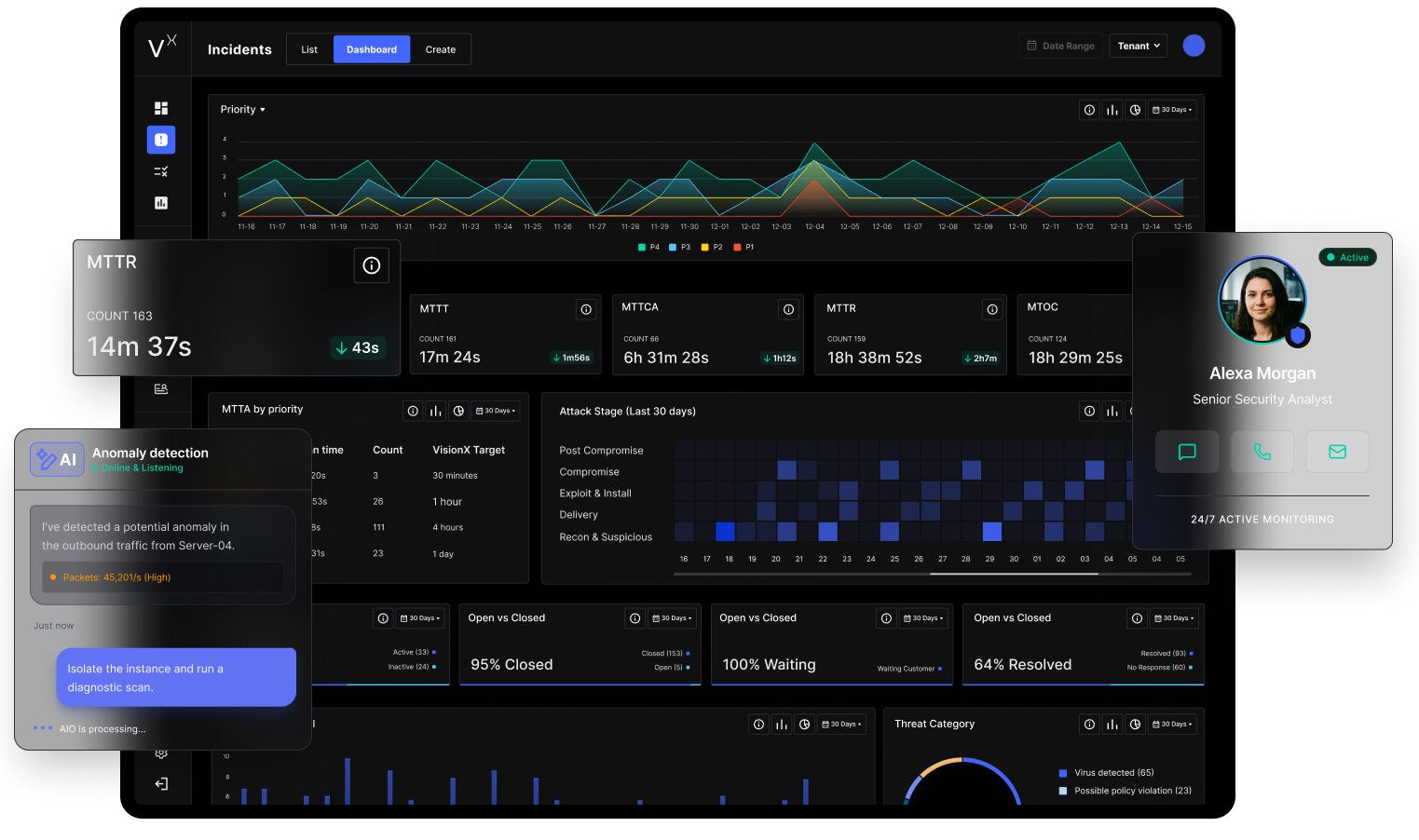
VisionX: The MDR Command Ceneter

The Compliance Advantage

GDPR compliance isn’t just about avoiding fines. It’s about building a security culture that values transparency and accountability. Incident detection gives you that edge. It enables fast response, preserves evidence, and protects your reputation when the inevitable happens.

Organisations that invest early in detection and response don’t just comply: they demonstrate maturity, responsibility, and respect for the individuals whose data they hold.

Read Our Latest Blogs

Blog Image
Iran Cyber Activity Focuses on Industrial Systems and Data Leaks

Iran-linked cyber activity targets industrial systems, data leaks, and human vulnerabilities, with risk centred on access, exposure, and operational control

Blog Image
North Korean Supply Chain Attacks, Chrome Zero-Day Exploit, and Qilin EDR Bypass

An in-depth look at major cybersecurity threats including North Korean supply chain compromises, a critical Chrome zero-day exploit, and Qilin ransomware

Blog Image
Claude Mythos: What Security Leaders Should Take Away

AI models like Claude Mythos are accelerating vulnerability discovery and exploitation, compressing attack timelines and increasing pressure on defenders.

Bg ShapeBg Shape
BLOGS & INSIGHTS

Incident Detection for GDPR Compliance

Compliance and Risk
Smarttech247 Research Team
Insights and Intelligence
October 14, 2025

The General Data Protection Regulation (GDPR) doesn’t just focus on how organisations collect and store data. It also demands that they know when that data has been compromised and can prove they acted fast. Without strong incident detection and response capabilities, even a small breach can escalate into a regulatory and reputational disaster.

Under GDPR, every organisation handling EU personal data must be able to detect, report, and investigate security incidents. Article 33 is clear. You have 72 hours to notify regulators once you become aware of a breach. That’s not much time. If you don’t have the systems and people in place to spot an incident quickly, compliance becomes impossible.

GDPR is intentionally technology-neutral. While Articles 33 and 34 define when and who organisations must notify following a personal data breach, the regulation deliberately avoids prescribing how incidents should be detected.

That responsibility falls squarely on the organisation. As outlined in Article 32, rather than mandating specific tools or controls, GDPR expects organisations to implement “appropriate technical and organisational measures” based on their risk profile. In practice, this means being able to:

  • notice anomalous or suspicious activity
  • identify whether that activity constitutes a security incident
  • assess whether personal data is involved
  • determine whether the incident qualifies as a reportable personal data breach

Only once those steps are completed can an organisation be said to have “become aware” of a breach and trigger the 72-hour notification requirement under Article 33, which is why having a clearly defined incident response plan is critical. Good incident response management initiavtives provide the operational discipline behind this obligation, ensuring incidents are detected, escalated, and stabilised within defined timeframes, and that performance can be measured, improved, and demonstrated through metrics such as Mean Time to Detect (MTTD) and Mean Time to Respond (MTTR). This approach gives organisations flexibility, but it also removes excuses. If an incident goes undetected for weeks or months, regulators will not accept the absence of tooling or visibility as a defence. They will assess whether reasonable measures were in place to identify the breach in a timely manner.

Why Detection Capability Determines GDPR Outcomes

In regulatory investigations, late reporting is rarely treated as an isolated failure. It is usually a symptom of deeper issues, such as inadequate monitoring, fragmented visibility, or unclear escalation paths.

Organisations that struggle to detect incidents early often face the same problems:

  • limited insight across endpoints, networks, and cloud environments
  • alert fatigue masking real threats
  • manual investigation slowing decision-making
  • poor correlation between security events and data exposure

Without effective detection and response capabilities, GDPR compliance becomes reactive rather than demonstrable. Organisations may eventually report a breach, but they cannot prove that they took reasonable steps to identify and contain it promptly.

Why Detection Sits at the Heart of GDPR

  1. Speed determines compliance
    You can’t respond to what you can’t see. Monitoring tools, threat intelligence, and alerting systems give you the visibility you need to act before that 72-hour clock runs out.
  2. Proof of due diligence
    Regulators expect evidence that you had detection measures, audit logs, and documented response workflows in place before an incident occurred.
  3. Minimising impact on data subjects
    Early detection reduces harm to individuals. If you can contain a breach quickly, fewer records are exposed, and customers maintain trust.
  4. Reducing financial and reputational fallout
    GDPR penalties can reach up to 4% of annual global turnover. Rapid detection and containment demonstrate accountability and can mitigate enforcement action.

Closing the Detection Gap with Managed Detection and Response

This is where managed detection and response (MDR) becomes a practical enabler of GDPR compliance.

Smarttech247’s Managed Detection and Response (MDR) service provides 24/7 SOC monitoring, detection engineering, and incident response across critical environments. By combining human expertise with advanced analytics, MDR helps organisations identify suspicious activity early, assess its impact, and respond decisively before regulatory timelines are breached.

MDR supports GDPR obligations by:

  • detecting potential security incidents in real time
  • investigating whether personal data is affected
  • preserving forensic evidence and audit trails
  • enabling faster, more confident breach assessment

Rather than relying on best-effort monitoring, organisations gain a consistent, defensible detection capability aligned to regulatory expectations.

Building a GDPR-Aligned Detection Capability

  1. Implement continuous monitoring
    Use SIEM, MDR, or XDR platforms to monitor network and endpoint activity around the clock. Continuous visibility is essential for identifying suspicious events in real time.
  2. Develop an incident response plan
    Define clear roles and escalation paths. Include technical teams, compliance officers, and PR functions. Test the plan regularly with tabletop exercises.
  3. Document everything
    From detection to resolution, maintain full audit trails. Logs prove you took reasonable measures — that evidence is critical during a regulatory review.
  4. Integrate detection with data protection measures
    Connect your detection tools with your data classification and access control systems. When an alert fires, you can instantly understand what kind of personal data is at risk.
  5. Leverage automation where possible
    Automated correlation and alerting help teams respond faster and reduce false positives. The faster you can confirm a breach, the faster you can comply.
  6. Work with trusted partners
    Managed detection and response (MDR) providers can bridge capability gaps, offering around-the-clock coverage and forensic support when your internal teams are stretched.

Visibility and Accountability with VisionX

Detection alone is not enough. Security leaders also need visibility and assurance.

VisionX, Smarttech247’s MDR platform, provides a transparent view of live threat intelligence, active investigations, and response actions. It gives CISOs and compliance teams real-time insight into what is happening across their environment, without waiting for incident summaries or post-event reports.

For GDPR compliance, this visibility is critical. VisionX enables organisations to:

  • demonstrate awareness of security events as they unfold
  • understand which assets and data types are at risk
  • support timely internal escalation and regulatory decision-making
  • evidence due diligence during audits and investigations

By combining continuous detection with clear operational visibility, organisations are better positioned to meet both the letter and the spirit of GDPR.

VisionX: The MDR Command Ceneter

The Compliance Advantage

GDPR compliance isn’t just about avoiding fines. It’s about building a security culture that values transparency and accountability. Incident detection gives you that edge. It enables fast response, preserves evidence, and protects your reputation when the inevitable happens.

Organisations that invest early in detection and response don’t just comply: they demonstrate maturity, responsibility, and respect for the individuals whose data they hold.

Smarttech247 Research Team

Insights and Intelligence

Our content team turns real-world cybersecurity operations into clear, practical insight. We work directly with service delivery, threat intelligence, and incident response teams to ensure accuracy and credibility. We focus on resilience over fear, explaining how organisations reduce risk, detect threats faster, and recover confidently.

Contents:

Ready to scale your security and compliance operations?

We protect your on-premise/cloud/OT environments - 24x7x365